Showing posts with label ruth rendell. Show all posts

Thursday, September 26, 2013

The Book Report

Quick catch-up on some of the books I've been reading lately.


JDM's second novel, and it shows, especially in the dialogue, which has a hackneyed, pulled-from-the-movies feel to it. There are set pieces in it, however, that are pretty tense, including an unforgettable showdown at a shack on the outskirts of New Orleans that involves a vicious dog, a hired killer, and an unconscious victim. Other than that, not so good, and as far as I know, the only JDM thriller in which the bad guys are international spies. Didn't work.


Not her best gothic family drama, but a very good read about a mother who will go to any lengths to make sure her daughter has no contact with the outside world. A little slow-going at times, but the ending, especially the last two chapters, are surprising and excellent.


Now this is JDM in his wheelhouse, describing the political and sexual shenanigans that take place during a weekend business conference in an unnamed city. Incredibly grim, this is like the saddest Mad Men episode you'll ever see.


Robert Bloch's Psycho was a big hit before the movie eclipsed it. Hitchcock did not change a lot. The book practically reads as a scene for scene treatment of the movie, except for details here and there. A very creepy book, obviously, and even knowing exactly how it would turn out, I enjoyed it a lot.

Tuesday, July 10, 2012

The Book Report

I'm behind on my Book Reports, just like a kid nearing the end of summer. So, some quick recaps:


A truly forgotten novel from 1966 (there is almost nothing on this online) and undeservedly so. This is a brilliant, frightening story about a renegade group of right-wing warriors bent on taking global politics into their own hands. Their scheme involves the securing of a particular Florida Key and the hijacking of a coast-guard cutter. Ed McBain/Evan Hunter is such a great writer that he manages to flesh out about twenty-five characters. My only complaint is that he goes for a somewhat rushed ironic ending and the book ended far too soon.


I'm not a fan of that "meh" expression but it fits sometime. I think it's a way of saying there's nothing particularly bad about a book (or whatever) but it just didn't float your boat. That's how I felt about this particular Saratoga mystery.


This 1970s French noir is somewhere between a straight-ahead high-body-county existential thriller and a satire of capitalism. It's pretty riveting, and very very strange, either way.


Not the best Wexford, although the mystery, involving illegal birth surrogacy, is fairly well thought out. What took this one down a few notches was a subpar subplot (I should start a lit magazine and call it that) involving an overly-PC police detective with a crush on a co-worker. Forgettable.

Monday, March 5, 2012

The Chimney Sweeper's Boy (1998)

Ruth Rendell, writing here under her pseudonym Barbara Vine, has many admirable skills, foremost of which is the ability to write entire novels populated with essentially unlikable characters. It's no small feat, and it allows her to write these gripping, sordid family histories (usually as Vine), such as this one, in which the secrets of a dead novelist are uncovered by his grown daughter, a budding alcoholic and agoraphobe. This is one cold book but sometimes cold books provide their own kind of comfort. I think this one goes on a little too long, piling up the red herrings, but it's a small flaw in an otherwise excellent novel.

Monday, February 6, 2012

Murder Being Once Done (1972)

An Inspector Wexford that takes place in London, not Kingsmarkham. Wexford is recuperating from a mild stroke at his nephew's house and takes on a local murder, an unidentified girl left in a rundown grave in the fictional borough of Kenbourne Vale. There are about seventy-five red herrings then the truth is revealed, Wexford getting to show up the younger London detectives. Has Wexford always been old? I think so. Anyway, it's another good one for Rendell.

Wednesday, January 4, 2012

Ten Favorite Books of the Year

My favorites of the books I read this year, not necessarily books that came out this year (or anywhere near this year) ...


10. Bonecrack (1971)

All of Francis' books are pretty much the same, just either good or bad. This was very good.

9. The Hunger Games (2008)

I could've put the trilogy here, since I read them all, but the first book, much as I liked the follow-ups, was the real barn-burner of the bunch. Let's hope the movie is half as good.


Sometimes we don't need fuzzy characters or moral uplift. Sometimes it's uplifting to read about a degenerate plotting to kill his mother-in-law and his wife. Sometimes.


Not King's best collection of novellas, but certainly his grisliest. It's nice to know that the old fella can still make your skin crawl.

6. Mad World (2010)

A rare non-fiction appearance. This is the fascinating true story of Evelyn Waugh and the family that inspired Brideshead Revisited.


Boyd's very funny first novel, with a protagonist worthy of Kingsley Amis at his best.


I prefer Cordelia Gray to Dalgliesh somehow. My favorite of James' mysteries.


MacDonald at his height, telling a multi-character tale of corruption and redemption.

11/22/63 (2011)

Simply a great page-turner, with some nice asides thrown in about history, America, and the passage of time.

1. Any Human Heart (2002)

It's hard to imagine a year in which this wouldn't be my favorite book. Maybe the year I read Lucky Jim, of course, or the year I read Brideshead Revisited. An epic and human tale.

Thursday, December 8, 2011

The Vault

Ruth Rendell writes three different types of novels. Under her own name she writes creepy standalone thrillers, often based around unstable psychopaths or neurotics, plus the Inspector Wexford series of more typical whodunits. Under her pseudonym Barbara Vine she writes disturbing gothic family tales. I haven't read much Vine but I find that I really love Rendell whatever mode she is writing in. This, her latest book, is strange, in that it is a Wexford novel (brought onto a case as an adviser since he is now retired), that also happens to be a sequel to one of her great standalones, 1999's A Sight for Sore Eyes. That book ended with three bodies sealed away in a hidden cellar, and this book opens with that cellar being discovered, only there is now a fourth body interred along with the rest. Truthfully this book was a little bit thin and you could feel that the pages were being padded with many red herrings and a subplot (an interesting subplot) about Wexford's difficult grown daughter. That aside, Rendell is such a compelling writer, and her characters so good, that I enjoyed this book as much as I've enjoyed anything for a while.

Sunday, July 10, 2011

Book Report

I'm behind on my book reviews but I have been doing some extremely enjoyable summer reading. Some of it has been done on a beach but, truth be told, most of it has been done with me cozied up to an air-conditioning unit.

One Across, Two Down (1971)
A lazy sad sack in suburban England plots to murder his mother-in-law. Very few of the characters are likable but Ruth Rendell is so masterful that this will-he-get-away-with-it is completely absorbing.

The Girl in the Plain Brown Wrapper (1968)
An excellent McGee novel by John D. Great bad guy, good location, lots o' ladies. I'm sure I read this before when I was 14 but I was glad to read it again.

Nightmare in Pink (1964)
Pretty sure I've never read this McGee. I thought it was just okay but didn't know while I was reading it that it was the second novel. I changed my tune a little: the novel sets the tone for some of the tropes that John D. perfected later. Plus, the "shock corridor" third act twist in this book is both ludicrous and a lot of fun.

Loot (1999)
A very enjoyable art-heist thriller that takes place partly in Boston. It's one of those mysteries that manages to be a history lesson at the same, detailing the complicated process of returning looted art to their rightful owners after World War II.

The Last One Left (1967)
Slow-going at first this book escalates into one of MacDonald's best. It's full of multiple perspectives and time-jumps, and has one of MacDonald's nastiest villains ever: Chrissy Harkinson, an aging gold-digger going for one last big score.

Tuesday, December 28, 2010

Ten Favorite Books of 2010

My ten best reads of 2010, heavy on Mr. MacDonald.

10. From Doon With Death by Ruth Rendell (1964)
Her first book, and it's as good as anything she's written.

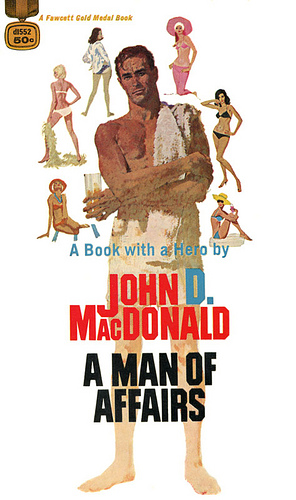
9. A Man of Affairs by John D. MacDonald (1965)


Is it as good as this cover suggests? Pretty much.

8. Imperial Bedrooms by Bret Easton Ellis (2010)


Is it a detective story? A veiled autobiography? Moral satire? A horror story? I'm not exactly sure but it's pretty close to all of the above. Not for the faint of heart.

7. The Pale Horse by Agatha Christie (1961)


Outlandish, then clever. I have a particular fondness for the Christie novels that initially seem to be about something supernatural but then turn out to have a perfectly logical solution. The prototype for every Scooby Doo mystery by the way.

6. The Pregnant Widow by Martin Amis (2010)


He almost lost me in the muck of his self-conscious prose but the epilogue pulled me back in. Some of the finest writing Martin Amis has ever done.

5. The Deceivers by John D. MacDonald (1968)


A story of suburban infidelity that's as suspenseful as a murder mystery. John D. Macdonald is all about those truthful little details that make the world come alive, and this book is no exception. He really makes you feel both the thrill and the devastation of adultery.

4. The Little Stranger by Sarah Waters (2009)


A ghost story for a cold winter night. Well, several cold winter nights. It's a long book but with a huge payoff.

3. The Soft Touch by John D. MacDonald (1953)


Long before Travis McGee breathed fictional air John D. was writing perfect pulp novels.

2. A Study in Scarlet by Arthur Conan Doyle (1887)


A perfect introduction to Holmes and Watson, and even though the Mormon sequence is historically inaccurate it makes for great pulp fiction.

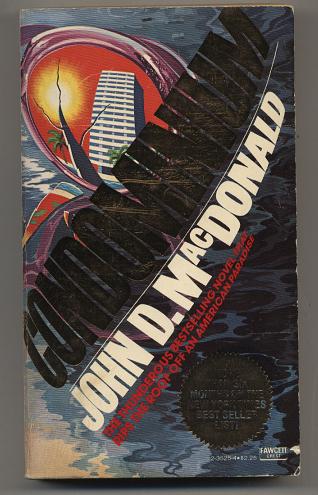
1. Condominium by John D. MacDonald (1977)


Maybe his greatest achievement.

Tuesday, December 21, 2010

From Doon With Death (1964)


Ruth Rendell's first published mystery, and also the first Inspector Wexford. It's excellent, and really goes to show that sometimes a good mystery novel only needs one good idea. In this case, the key to the murder of a local dowdy woman seems to be a trunkful of books, all inscribed to her by the mysterious Doon. The ending is relatively surprising now but must have been downright shocking in 1964.