
Showing posts with label books. Show all posts
Showing posts with label books. Show all posts
Tuesday, October 7, 2014

Monday, May 19, 2014

Tuesday, March 4, 2014
Crime Time Piece
I was halfway through writing The Girl With a Clock for a Heart when I realized that a character in my story, Irene, not only served the same narrative purpose as the character Midge in Hitchcock's 1958 masterpiece Vertigo, but that she looked like her as well. I had described Irene, who is the protagonist's on-again, off-again girlfriend, as having shoulder-length blonde hair that flips out a little, and as wearing glasses. That's Midge, all right, as played by the excellent Barbara Bel Geddes. So now I'm telling people that Irene is an homage to Midge—and she is, of course—but, in reality, the character just bubbled up out of my subconscious. Not surprising, since my subconscious is absolutely jam-packed with the films of Alfred Hitchcock, and has been, ever since I was a kid.
Read more on Crimetime.co.uk
Read more on Crimetime.co.uk
Wednesday, February 26, 2014
Some reviews ...

The Girl With a Clock for a Heart has been out for a few weeks now. I don't know how it's selling, but it has gotten some nice reviews. I haven't read them word-for-word, just scanned them, and read the good bits, of course.
This means that when a bad review comes in, I won't feel guilty about not reading that one either.
Anyway, here are a few links.
The Washington Post
The Boston Globe
The Lancashire Evening Post
The Guardian
Wednesday, January 29, 2014


Sunday, January 12, 2014
Two classic fugitive novels
For a while now I've been working my way through the generally accepted crime classics. I happened to get these two novels from the library at the same time. They have a lot in common. Early seventies. Debut novels. Both turned into iconic films. Both about men on the run. And they're both excellent reads, never mind the fact that the man on the run book (or woman on the run, although I can't think of one of those right now) is one of my favorite storylines.

James Grady's 1974 Six Days of the Condor is about a desk-bound CIA agent analyst who is suddenly being hunted by the agency he works for. It's a pretty exciting, quick read, although the cutaways to the CIA agents tracking down the hero were less exciting than the rest of the book.

The 1972 First Blood was my favorite of the two. Just an unrelenting story about two war veterans caught in a no-win situation. This, of course, produced the more famous movie of the two, but the film, while following the essential plotline, is pretty different. Read this, if you haven't. A very dark thriller.
Thursday, September 26, 2013
The Book Report
Quick catch-up on some of the books I've been reading lately.

JDM's second novel, and it shows, especially in the dialogue, which has a hackneyed, pulled-from-the-movies feel to it. There are set pieces in it, however, that are pretty tense, including an unforgettable showdown at a shack on the outskirts of New Orleans that involves a vicious dog, a hired killer, and an unconscious victim. Other than that, not so good, and as far as I know, the only JDM thriller in which the bad guys are international spies. Didn't work.

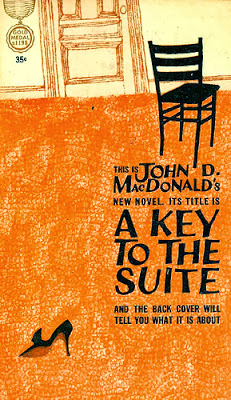
Now this is JDM in his wheelhouse, describing the political and sexual shenanigans that take place during a weekend business conference in an unnamed city. Incredibly grim, this is like the saddest Mad Men episode you'll ever see.


JDM's second novel, and it shows, especially in the dialogue, which has a hackneyed, pulled-from-the-movies feel to it. There are set pieces in it, however, that are pretty tense, including an unforgettable showdown at a shack on the outskirts of New Orleans that involves a vicious dog, a hired killer, and an unconscious victim. Other than that, not so good, and as far as I know, the only JDM thriller in which the bad guys are international spies. Didn't work.

Not her best gothic family drama, but a very good read about a mother who will go to any lengths to make sure her daughter has no contact with the outside world. A little slow-going at times, but the ending, especially the last two chapters, are surprising and excellent.

Now this is JDM in his wheelhouse, describing the political and sexual shenanigans that take place during a weekend business conference in an unnamed city. Incredibly grim, this is like the saddest Mad Men episode you'll ever see.

Robert Bloch's Psycho was a big hit before the movie eclipsed it. Hitchcock did not change a lot. The book practically reads as a scene for scene treatment of the movie, except for details here and there. A very creepy book, obviously, and even knowing exactly how it would turn out, I enjoyed it a lot.
Monday, August 26, 2013
Tick Tock

A nice review of The Girl with a Clock for a Heart (nice because he likes it, but also nice because of how well he writes.)
Will posted this review on Good Reads, and after I told him how much I appreciated it, he asked if he could interview me. So after the review, there are a few questions I answered via email.
Tuesday, August 20, 2013
Elmore Leonard

The first Elmore Leonard novel I read was Glitz, when it came out in 1985. I loved the whole book but was particularly in love with the first chapter. I must have read it ten times.
Elmore Leonard died yesterday at the age of 87. I haven't read all his novels but I hope to. He's brought so much pure entertainment into my life, and it's nice to know there are books of his I haven't read yet.
Below is the first chapter of Glitz, a chapter I will always love, and a chapter that every aspiring writer would do well to study.
***
The night Vincent was shot he saw it coming. The guy approached out of the streetlight on the corner of Meridian and Sixteenth, South Beach, and reached Vincent as he was walking from his car to his apartment building. It was early, a few minutes past nine.
Vincent turned his head to look at the guy and there was a moment when he could have taken him and did consider it, hit the guy as hard as he could. But Vincent was carrying a sack of groceries. He wasn’t going to drop a half gallon of Gallo Hearty Burgundy, a bottle of prune juice and a jar of Ragu spaghetti sauce on the sidewalk. Not even when the guy showed his gun, called him a motherfucker through his teeth and said he wanted Vincent’s wallet and all the money he had on him. The guy was not big, he was scruffy, wore a tank top and biker boots and smelled. Vincent believed he had seen him before, in the detective bureau holding cell. It wouldn’t surprise him. Muggers were repeaters in their strungout state, often dumb, always desperate. They came on with adrenaline pumping, hoping to hit and get out. Vincent’s hope was to give the guy pause.
He said, “You see that car? Standard Plymouth, nothing on it, not even wheel covers?” It was a pale gray. “You think I’d go out and buy a car like that?” The guy was wired or not paying attention. Vincent had to tell him, “It’s a police car, asshole. Now gimme the gun and go lean against it.”
What he should have done, either put the groceries down and given the guy his wallet or screamed in the guy’s face to hit the deck, now, or he was fucking dead. Instead of trying to be clever and getting shot for it.
This guy wasn’t going to lay himself out against any police car, he had done it too many times before—as it turned out—and it didn’t pay. He shot from the hip and that was where Vincent took the first one, in his own right hip, through and through. The .38 slug chipped bone, nicked the ilium, missed the socket by a couple of centimeters but raised other hell in its deflected course: tore through his gluteus maximus, taking out his back pocket and wallet containing seventeen dollars and punched his gun out of the waistband of his pants, where it rode just behind his hip. The guy’s second shot went through the HeartyBurgundy, passing between Vincent’s right arm and his rib cage. At this point Vincent dropped the groceries and went for his piece, yelling at the guy, who was running now, to halt or he’d fire. Here again was a lesson to be learned. When you say it, mean it. The guy halted all right, he half-turned and started shooting again. By now Vincent was on the ground feeling for a Model 39 Smith & Wesson nine-millimeter automatic among broken glass and spaghetti sauce. He found it and fired, he believed, four rounds, three of them entering the guy’s body just under his right arm and passing through both lungs.
The Sinai Emergency staff tore Vincent’s shirt off looking for a chest wound until one of them sniffed him and said, Christ, it’s wine. They x-rayed him,closed the exit wound in surgery, attached some plastic tubes and cleaned glass out of both of his hands.
He was in Intensive Care for the night, wheeled the next morning to a private room as somebody special. The nurse who came in said, “Well, you look just fine to me.” Vincent said, thank you, he was. Except for a terrible pain, down there. Pointed and said, “In my penis.” He had never called it that before. The nurse took it in her hand, gently removed the catheter and he fell in love with her, her perky cap, her perfect teeth, her healthy body in that starched white uniform. At night she rubbed hospital lotion over his back, his shoulders, soothed that raw gluteus muscle in his right buttock and he called her Miss Magic Hands. Her name was Ginny. Deeply in love he told her the front of his hip hurt too, awful, right there where the leg met the body. Ginny gave him a sly smile and the plastic bottle of lotion. He asked her if she’d like to go to Puerto Rico.
He was going. He’d been once and loved the food. Went down to pick up a wanted felon and waited over a long weekend for a judge to sign the release. He got to visit with a friend of his on the Puerto Rico Police, but didn’t get out to Roosevelt Roads that trip. His dad had shipped out of there and was killed at Anzio, taking in an LCVP during the invasion of Italy. Vincent wanted to see Roosevelt Roads. He had a picture of his dad at home taken at El Yunque, up in the rain forest: the picture of a salty young guy, a coxswain, his white cover one finger over his eyebrows, grinning, nothing but clouds behind him up there on the mountain: a young man Vincent had never known but who looked familiar. He was twenty years older than his dad now. How would that work if they ever did meet? His mother said rosaries in the hope they would.
The guy he killed was running on speed and trailing a life-time of priors, destined—they told Vincent—to crash and burn or die in jail.
“I didn’t scare him enough,” Vincent said.
He told this to his closest friend on the Miami Beach Police, Buck Torres.
Torres said, “Scare him? That what you suppose to do?”
Vincent said, “You know what I mean. I didn’t handle it right, I let it go too far.”
Torres said, “What are you, a doctor? You want to talk to the asshole? You know how long the line would be, all the assholes out there? You didn’t kill him somebody else would have to, sooner or later.”
“Don’t you know what I’m talking about?” Vincent said. “If I’d scared him enough he’d still be alive. I mean scare the guy so bad he stops and thinks, he says, man, no more of this shit.”
Torres said, “Yeah? How do you know when you scared him enough or you have to shoot him to save your own life? Right in there, that moment, how do you know?”
That was the question.
He’d take it with him to Puerto Rico on his medical leave. Maybe think about it while he healed, maybe not. Lieutenant Vincent Mora was at a point, he wasn't sure he wanted to be a cop anymore. Until that night he had never killed anyone. It made him think about his own life.
Tuesday, August 13, 2013
You Live Once (1956)

JDM's 16th novel, and a bit of a dud. In particular, the writing seems rushed, and not up to his usual high standards. The typical MacDonald hero, a business executive, discovers the murdered body of the girl he's been dating in his closet. He covers up the crime, then has to out-run the police to try and find out who did it and framed him. The love interest is particularly weak in this book.
.jpeg)
In this period of time, JDM was cranking out novels at the rate of probably three or four a year so it's not surprise that not all of them work. Can't win 'em all.
Sunday, July 28, 2013
Judge Me Not (1951)

An early thriller from JDM, and a good one. It's his version of the dirty town thriller, as the flawed and manly lead (natch), works against the extremely corrupt factions of a small northern city. It's super pulpy, loaded with violence (pretty extreme), greed, and sex. There's a hooker with a heart of gold, and instead of being a terrible cliche, she's actually a decent character.


Thursday, July 25, 2013
Rogue Male (1939)

Another book that always shows up in lists of the greatest mystery novels of all time. It was hard to find, but I got a used copy and checked it out. The book is in the man-on-the-run genre. An English aristocrat (we never learn his name) is hunting in a foreign country (almost certainly Germany) and decides to see if he can stalk and kill a dictator (Hitler). He almost succeeds but is caught, tortured, and left for dead. All of this, by the way, is in the first few pages of the book. After that, he is on the run across Europe and then back in England, where he literally goes to ground, creating a burrow where he lives.

This is one strange book, but completely compelling, especially the sequence in Dorset, where the narrator creates his hidey-hole. Beautiful descriptions of the landscape combined with a genuine sense of what it feels like to be hunted. A classic for a reason.
Wednesday, July 17, 2013
Last Seen Wearing (1952)

One of those novels that consistently ranks in any top 100 mysteries of all time list. It's long been a book that I've been meaning to check out, but I haven't been able to find a copy from any of the used books sites that I go to. So I resorted to the library, and was glad I did. This is a straight-up procedural, following the case of a missing college student from the points of view of the police force. Apparently, this was a first-of-its-kind, setting the stage for about a hundred Ed McBain novels, and about ten thousand Law and Order episodes.

What's nice, though, is how riveting this book is. It doesn't resort to tricks, or impossible murders, or quirky detectives. It just unfolds like an actual police investigation, the detectives getting closer and closer to the truth. It's dated, but in a good way, like a time capsule that shows you how college students lived in the early 1950s.

Sunday, July 7, 2013
One More Sunday (1984)

An excellent late novel from JDM. It was new subject material for him, as he portrays the machinations of a mega-church. There's a murder as well, but it takes a backseat to the financial and sexual shenanigans of the church's hierarchy. My big problem with this novel is that there are just too many characters, and that the book loses a little bit of steam by not focusing more on one central character. But the writing is amazing.
Monday, June 24, 2013
Joyland

About the book: it's a solid Stephen King with lots of great atmosphere, a few creepy scenes, and a more than usual amount of nostalgia and heart-string-pulling. A coming-of-age novel set in 1973 at an independently-run carnival in the south, where narrator Devin Jones spends his summer. The novel meanders a bit, but I think that's the point. It's about all the experiences of this young man's life, from his first broken heart, his first sexual experience, his first close friendships. There's also a ghost and a serial killer, but they almost seem like subplots. A sweet book that doesn't quite live up to the pulpiness of its cover art, but that's in keeping with tradition.
Monday, June 10, 2013
Before I Go To Sleep

Best contemporary thriller I've read in a long time. Almost perfect, really. There's no reason for me to explain what happens in this book because you should just read it.
Tuesday, April 23, 2013
The False Inspector Dew

If anyone's read this, and has an opinion, please let me know.
And while I'm here, and while I'm on the subject of endings, I just finished watching Top of the Lake, Jane Campion's detective miniseries on Sundance Channel that stars an absolutely stunning Elisabeth Moss.
.jpeg)
Thursday, April 11, 2013
A Kiss Before Dying

Simply, one of the best suspense thrillers I've ever read. I don't know why I haven't read this before since I'm a big fan of Ira Levin's other works, especially his 1967 novel Rosemary's Baby, and his 1978 play Death Trap. This novel was his first, published in 1953. It tells the story of a sociopathic gold-digger and his involvement with three sisters.

What makes the book particularly compelling is that Levin gives you information as you go along (this is not a who-dun-it), and yet he hides information that you don't even know he's hiding. There are several great reveals throughout this novel.

There have been two American film versions of this novel, and I haven't seen either, but will try and check out the film made in 1956 that stars Robert Wagner.

Saturday, April 6, 2013
Funeral in Berlin

I'll admit that I've been reading this particular book in fits and starts, and even took a break to re-read Lucky Jim, but that doesn't mean I didn't like it. The plot, although not terribly complicated by cold-war spy novel standards, lost me a little, but Len Deighton's prose style and dialogue is so consistently good, that I was happy to read along even when I wasn't hundred percent sure what was going on.

They did a film version of this book with Michael Caine, reprising his role as Harry Palmer from The Ipcress File. I haven't seen it yet, but just ordered it from the library.

Tuesday, March 12, 2013
Lionel Asbo: State of England

Subscribe to:
Posts (Atom)


